
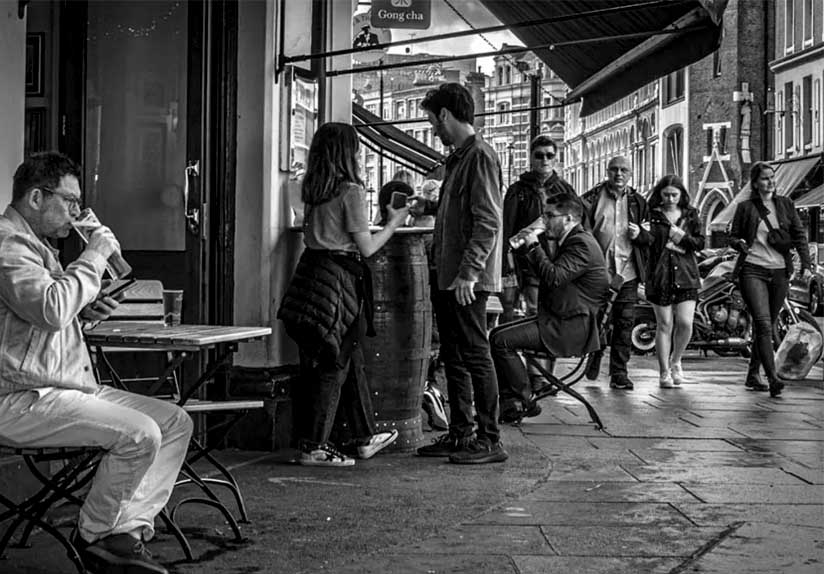
London Street Photography Shoot- Monochrome
BACK TO THE STREETS: WHAT FASHION PHOTOGRAPHY TAUGHT ME ABOUT SEEING
A collaborative street photography shoot in London with Kieron Beard reminded me why I began photographing real people — and what happens when the control of a commercial production disappears.
For more than thirty years, I've worked in fashion, advertising and editorial photography, often in situations where almost everything in front of the camera can be considered or controlled.
The model, the lighting, the background, the styling and the atmosphere. Sometimes those decisions are made weeks before a shoot. Sometimes they happen in seconds.
But what happens when you remove that control? When the subject cannot be directed, the light cannot be moved and the moment disappears whether you're ready or not?
That was part of my reason for returning to the streets of London. I wanted to revisit something that originally drew me to photography: the fascination of photographing real people.
What happens when control disappears?
In a fashion shoot, I can build the image. On the street, I have to recognise it. The challenge is to replace direction with observation, anticipation and the judgement to know when the photograph is there.
Before Fashion, There Were Real People
Before the fashion campaigns, professional models and elaborate productions, I was interested in photographing ordinary people. Their faces, expressions, gestures and the small details that make each person individual.
I've always been fascinated by character. Not simply whether somebody is conventionally beautiful, but what makes them interesting to look at.
As my photographic career developed, I moved into fashion, advertising, portraiture and editorial photography. I learned to control lighting, direct models, organise complex productions and build images around particular creative ideas.
But my interest in people never disappeared. Even in fashion photography, I've always believed character can outweigh conventional beauty. A genuine expression or unexpected gesture can make a photograph far more interesting than a carefully rehearsed pose.
Street photography takes me back to that original curiosity.
From an Online Friendship to the Streets of London
I'd become friends online with Kieron Beard, a street photographer based in Switzerland. Photography has a wonderful way of connecting people who might otherwise never meet.
Eventually, we decided to meet in person and arrange a collaborative street photography shoot in and around London. There was no commercial brief, no client waiting for pictures and no carefully planned production.
Just two photographers, our cameras and a city full of possibilities. We could walk, talk, share ideas and photograph whatever caught our attention.
Meet Kieron Beard
Kieron Beard is a street photographer based in Switzerland. We originally connected online through photography, and over time that connection developed into a friendship. Our shared interests led us to arrange a collaborative street photography day in and around London.
“Kieron and I got on really well from the start. Even though we worked in different fields, we discovered a lot of similarities in the way we approached our businesses and the challenges that come with creative work. Meeting in person felt like a natural extension of the conversations we'd already been having online.” — James NaderExplore Kieron Beard's Photography →
One of the things I find particularly interesting about photographing alongside another photographer is that you can stand in exactly the same place, looking at the same street, and recognise completely different photographs.
Kieron has his way of seeing. I have mine. Neither has to make the other's picture. We bring our own backgrounds, experiences and instincts to the images we make.
And that was really the point of the day. Not to compete, but to share the experience and enjoy the process of looking.
The Problem With Chasing Interesting Subjects
London is full of things that attract attention. People moving at different speeds. Architecture creating unexpected shapes. Reflections, shadows and moments of human behaviour that briefly come together before disappearing.
But having lots of interesting things around you doesn't necessarily mean you are making interesting photographs.
I've encountered the same problem in commercial photography. A beautiful model, impressive styling or spectacular location doesn't automatically produce a successful image.
The different elements still need to work together. And on the street, you have much less influence over those elements.
I found myself having to stop thinking about how I would construct the photograph and begin recognising where one might already exist.
The camera records the decisions already made. James Nader / Photographic Judgement
Discovery One: Find the Light Before the Person
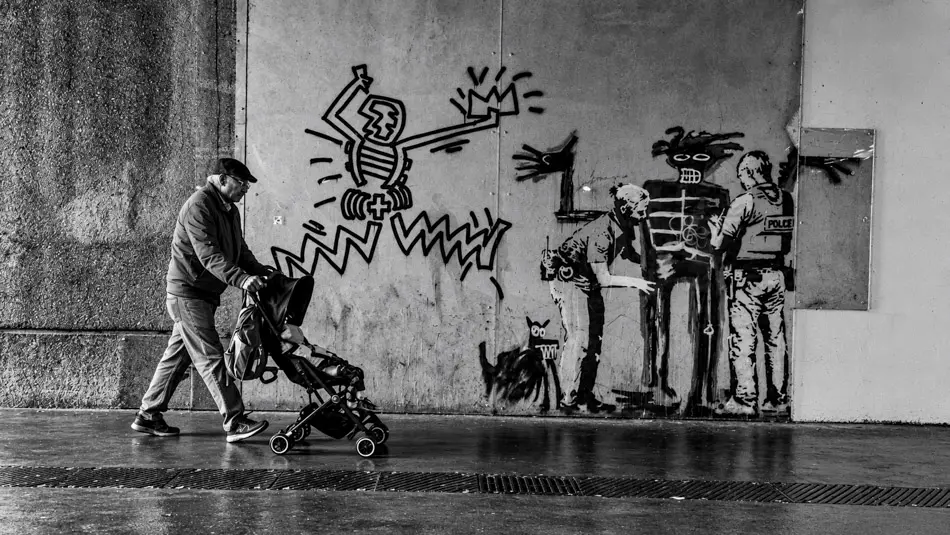
One of the environments I found particularly interesting was London's covered walkways and underpasses.
The heavy overhead structures created repeated geometric shapes and strong perspective. Beyond the darker sections, the streets opened into brighter daylight.
From a fashion photographer's perspective, some of these spaces almost resembled ready-made sets.
I could see where I might position a model. I could imagine how I would use the light and which backgrounds might give the subject greater separation.
But this time, I couldn't ask anybody to stand in a particular position. I had to recognise the environment first.
Where was the light falling? Which areas created separation? Where would somebody become a silhouette? What would happen when a person entered the brighter section of the frame?
The location was already providing the visual structure. I needed to observe how the human element interacted with it.
The location becomes the first subject.
Instead of chasing people, begin by studying the available light and establishing a composition. Then observe how people move through that space and recognise when their presence strengthens the photograph.
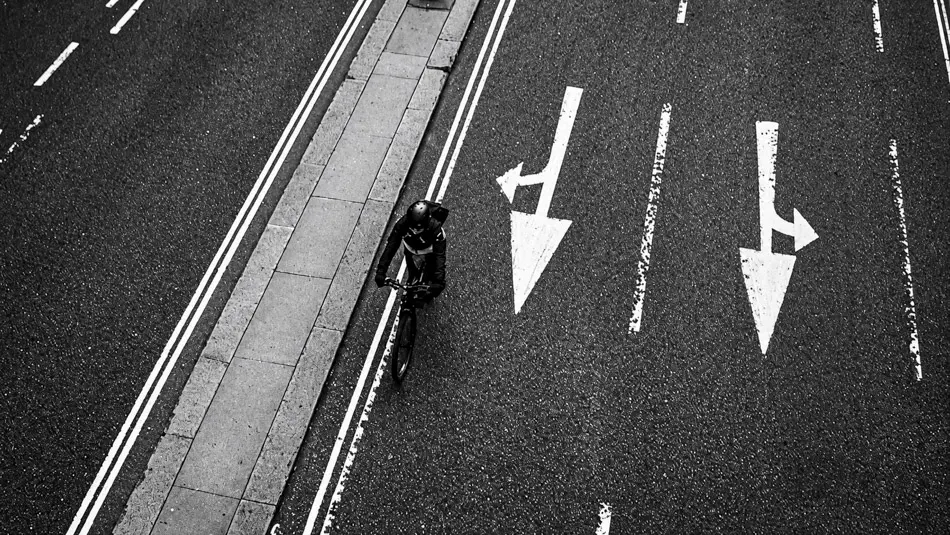
You cannot light what you have not seen. James Nader / Light and Observation
Discovery Two: The First Frame Isn't Always the Photograph
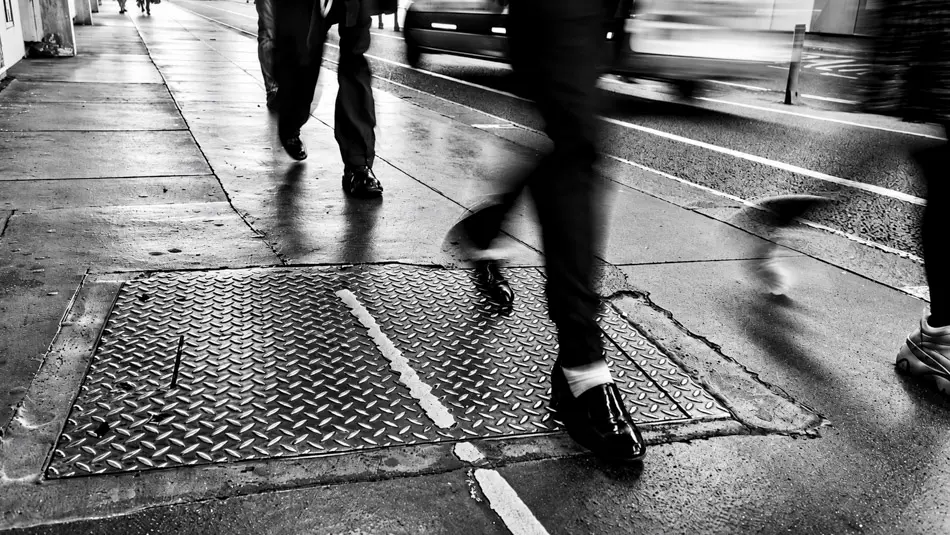
Some of the more interesting possibilities came from remarkably ordinary situations. People walking towards a station. Figures moving through a passage. Feet crossing a textured metal pavement cover.
One particular sequence involved photographing the changing relationship between pedestrians and the patterned surface beneath them. The first frame recorded the possibility.
But as the people continued moving, the arrangement of shapes and movement changed. Some frames became stronger. Others lost their visual balance.
That distinction is important. Recognising an interesting situation isn't the same as resolving it into a successful photograph.
You still have to consider the timing, balance and relationship between the elements.
Discovery Three: Character Is More Important Than Perfection
Some of the photographs I found particularly interesting involved people doing completely ordinary things.
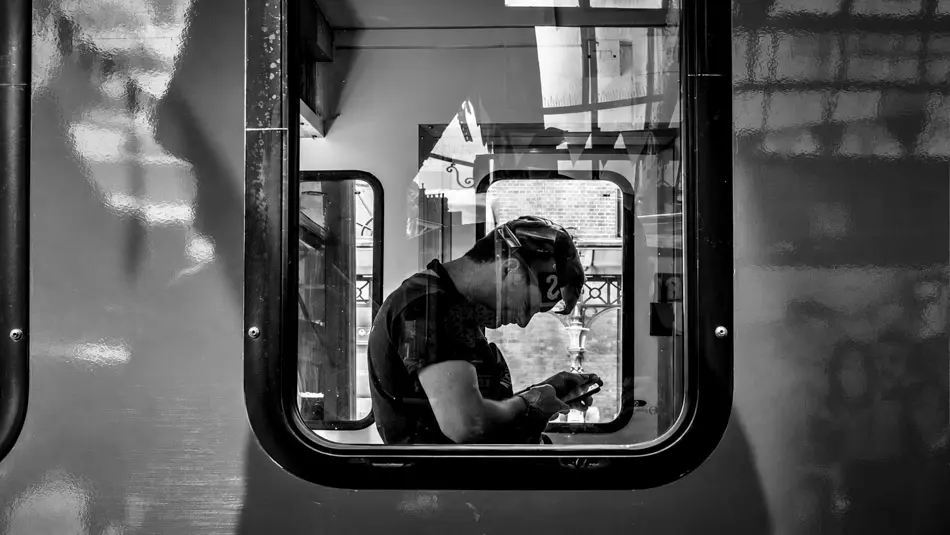
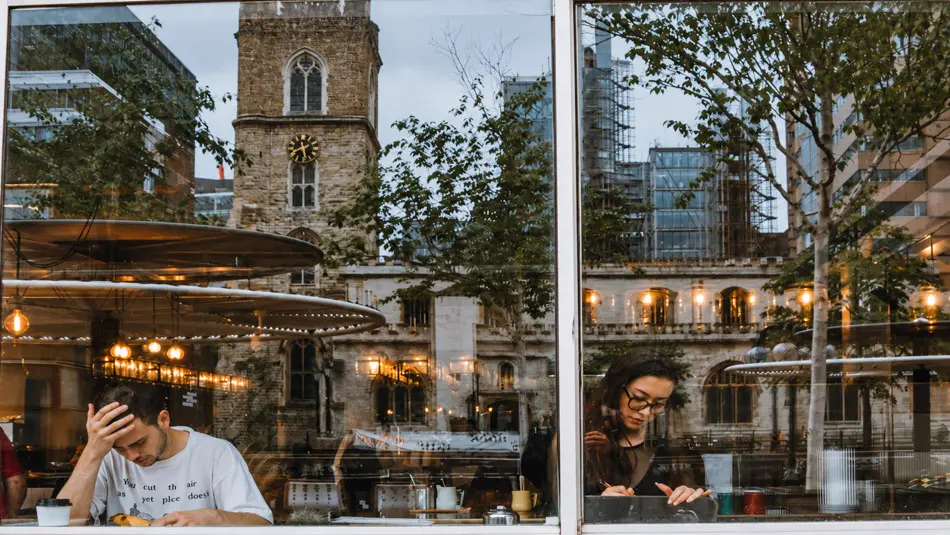
Two people sitting together, each absorbed in their own activity. A person looking at a phone through a train window. People passing one another without making eye contact.
Nothing especially dramatic was happening. But there were moments of character, gesture and human behaviour that made me want to preserve them.
That brought me back to something I've always believed in portrait and fashion photography. An interesting face or expression can carry more emotional weight than a technically perfect pose.
The challenge is to recognise that quality before it disappears.
The Solution: Change What You Control
By this point, something important was becoming clearer.
Street photography doesn't remove your ability to make decisions. It changes which decisions are available to you.
You may not be able to direct the person walking through the frame, but you can choose your position.
You may not be able to move the available light, but you can recognise its direction and understand how to use it.
You may not be able to repeat a gesture, but you can anticipate when something is about to happen.
These are the same principles I use when approaching visual problems in professional photography.
They also form the foundation of NVOS™, my professional photography operating system: Notice, Value, Organise and Solve.
Recognise Before You React
Choose one street location and spend ten minutes working within a small area.
- Notice. Study the light, movement and background before immediately taking photographs.
- Value. Identify one visual relationship that interests you.
- Organise. Move until the composition becomes more coherent and distractions are reduced.
- Solve. Anticipate when a person or gesture might complete the frame.
Afterwards, review your photographs. Don't simply choose your favourite. Identify why that particular frame works better than the alternatives.
The objective isn't to produce fifty photographs. It's to understand why one photograph deserves to exist.
My Transformation: Returning to Where I Started
I didn't return from London believing I'd discovered an entirely new approach to photography. Much of what I was doing came from years of working with people, light and composition.
But the day gave me an opportunity to use that experience without the expectations of a commercial brief.
I could work from curiosity. I could recognise something interesting simply because it attracted my attention.
And spending the day with Kieron reminded me how enjoyable it is to share photography with someone who sees the world differently.
The experience also reminded me that we should continue challenging ourselves creatively, however long we've been working professionally.
Back to the beginning, with a different eye.
I returned to photographing real people, but this time with decades of professional experience helping me recognise light, character and composition.
I didn't need to create every element. I could concentrate on recognising what was already there.
Your Transformation: Recognise Before You React
If your street photography produces lots of images but few memorable ones, the solution may not be another camera or a more interesting location.
It may be a different way of seeing.
Instead of immediately chasing subjects, begin by understanding the environment.
Find the light. Organise the background. Study the movement. Recognise the gesture.
Then decide when those elements become a photograph.
This approach applies far beyond street photography. Portrait photography, fashion, documentary, travel and commercial image-making all benefit from more deliberate visual decisions.
Stop collecting pictures. Start recognising them.
You don't necessarily need better subjects. You need to become more deliberate about the light, composition and human relationships already in front of you.
That is how photographic judgement begins to develop.
I believe that photography is less about taking photographs, and more about recognising the photograph that exists before the shutter is pressed. James Nader
The Next Challenge: Taking My Fashion Lighting Onto the Street
The London experience has encouraged me to explore a different kind of street photography.
Until now, much of my street work has involved observing people within their surroundings. I tend to look for the relationship between subject, environment and available light.
But there is another approach that has interested me for some time: the street photography of Bruce Gilden.
His photographs are direct, uncompromising and sometimes uncomfortable. The close proximity, strong flash and character of the people he photographs give the images a distinctive presence.
I'm not interested in imitating him. I'm interested in discovering what happens when I bring my experience of fashion photography, portrait lighting and human connection into a much less controlled environment.
I've now put together a small, portable setup using my Sony ZV-E10, an off-camera portable flash and a wireless synchronisation trigger.
Nothing resembling the equipment I would normally take onto a commercial production. Just a camera, a light and the freedom to respond to the people I encounter.
I want to create more direct, character-led street portraits, using the flash to give the face presence and shape.
That will present its own challenges. Approaching people requires confidence, sensitivity and respect for how they might respond. I want the interaction to be considered, rather than relying on surprise for its own sake.
Perhaps the result will sit somewhere between street photography and fashion portraiture. Perhaps it will develop into something entirely different.
That's what interests me.
After more than thirty years of photographing people professionally, I'm still curious about what happens when I approach someone with a camera.
A camera. A portable flash. Real people.
In some ways, I'm returning to where I started. But this time, I'm bringing everything I've learned along the way.
Five Decisions to Make on Your Next Street Photography Walk
- Find the light first
Study its direction, contrast and how it describes a subject before raising your camera.
- Organise the frame
Look for a meaningful relationship between background, space and architectural form.
- Anticipate movement
Recognise where a person might complete the composition rather than simply following them.
- Look for character
Pay attention to human gestures, expressions, posture and behaviour.
- Review your decisions
Understand why one photograph is stronger than another, rather than judging the session by the number of exposures.
Street Photography: 10 Frequently Asked Questions
1. Why would an experienced fashion photographer return to street photography?
Street photography removes many of the controls available on commercial assignments. It reconnects the photographer with observation, anticipation and spontaneous human behaviour. For me, it also returns to my earliest fascination with photographing real people.
2. What is the biggest difference between fashion photography and street photography?
In fashion photography, I can often direct the subject, position lighting and refine a composition. In street photography, I must recognise and respond to the conditions already present.
3. How can I improve my street photography composition?
Begin by studying the light, background and architectural structure. Choose a position that creates a coherent frame, then observe how people move through the composition.
4. How do I find interesting street photography subjects?
Look beyond unusual appearances. Expressions, gestures, behaviour and relationships between people can produce compelling photographs, even in ordinary environments.
5. Should I wait for a street photograph or continually walk around?
Both approaches can work. When a location already offers strong light and composition, waiting for the right human movement may produce a more deliberate image than constantly pursuing subjects.
6. How does fashion photography experience help with natural light street photography?
Professional lighting experience develops the ability to recognise light direction, contrast, tonal separation and the way light reveals form. Those skills remain valuable when the light cannot be moved or controlled.
7. What did photographing London with Kieron Beard teach you?
It reinforced how differently two photographers can interpret the same environment. It also reminded me of the creative value of photographing without commercial expectations and sharing the experience with another photographer.
8. Do I need expensive equipment to produce strong street photographs?
No. A camera you understand and can use confidently is often more valuable than extra equipment that distracts you from observation and timing.
9. Why use portable off-camera flash for street portraits?
Off-camera flash gives a photographer greater influence over the direction and character of light on a person's face. It can provide separation from the background and create a more direct portrait style. When photographing strangers, sensitivity and respect remain essential.
10. What practical street photography exercise should I try first?
Spend ten minutes in one location. Study the light, choose a composition, anticipate movement and photograph a short sequence. Afterwards, identify which frame works best and explain why.
No Comments