
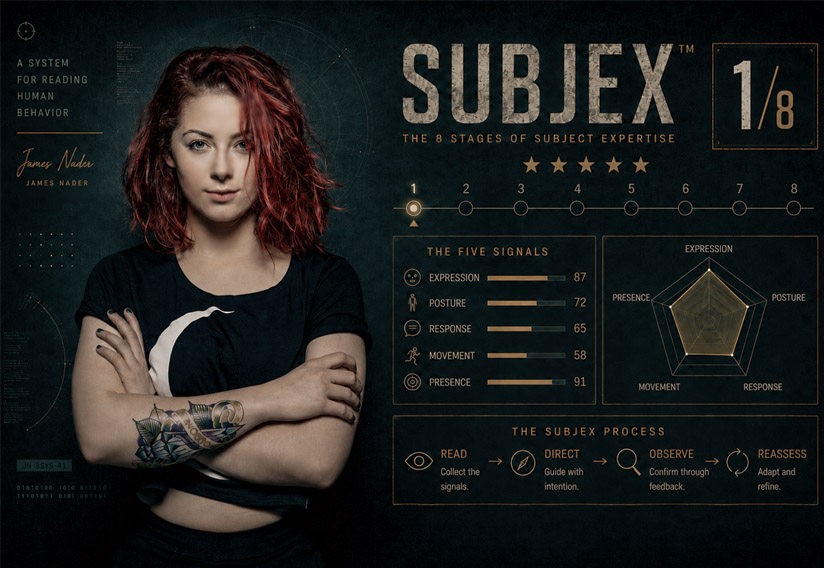
SUBJEX™ My eight-stage portrait system for reading a Subject
FIELD NOTES · PORTRAIT PHOTOGRAPHY · SUBJEX™
SUBJEX™: How I Learned to Read People Before I Directed Them
The eight-stage portrait system I developed to understand what a person needs from me, how they are responding to direction and how I can build confidence, connection and stronger photographs in front of the camera.
One of the hardest things to learn in portrait photography has very little to do with the camera. It is learning how to read the person standing in front of it. I came to this because I was struggling.
Not technically. I understood lighting, composition, lenses and how to construct a portrait. I had spent years working with professional models, performers, commercial subjects and people with almost no experience of being photographed.
The problem was much more subtle.
Some people responded almost immediately. Others needed much more help. Sometimes an instruction transformed the photograph; at other times, the same type of instruction seemed to make somebody increasingly aware of themselves.
I realised that giving direction was only one part of the process.
I needed to understand how that direction was being received.
Was I creating certainty or uncertainty? Was the person becoming more confident? Were they understanding what I wanted? Were they beginning to contribute? And was the way I was working making them feel increasingly comfortable in front of the camera?
I stopped thinking only about what I wanted the person to do and began concentrating on what they needed from me in order to do it.
That became the beginning of SUBJEX™.
WATCH · SUBJEX™ IN PRACTICE
Why People Become Awkward in Front of the Camera
Before going deeper into SUBJEX™, this film shows the problem that led me towards the system in the first place. I look at why people can become uncomfortable or overly conscious once a camera is pointed towards them, and how the way I communicate, reassure and direct them can change what happens next.
As you watch, notice that the objective is not simply to give more or less direction. It is to understand how the person is responding to me, how the instruction makes them feel and what that response tells me to do next.
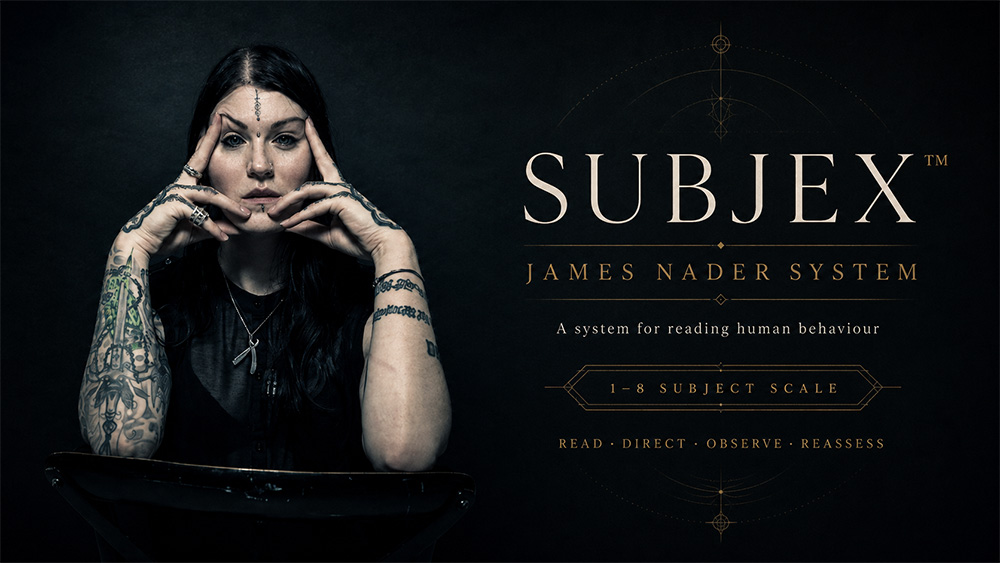
THE CENTRAL IDEA
The Instruction Is Only Half the Information.
The response tells me what to do next. SUBJEX™ became a way of observing the person, giving appropriate direction, watching how that direction was received and then adapting my approach accordingly.
WHY THIS MATTERS
Direction Is Communication
Portrait photography is often taught through visible solutions. We learn where the hands should go, how the shoulders should turn, where the weight should sit and which angle works for the face.
Those things matter enormously.
But underneath all of them is something more fundamental.
The person has to receive the direction.
Two people can be given exactly the same instruction and respond in completely different ways. One may immediately understand it and become more confident. Another may become uncertain.
One person may need a very precise instruction. Another may need the same idea explained differently. Someone experienced in front of the camera may understand a visual cue immediately, while another person may need more reassurance and context.
That is why I do not think of portrait direction simply as a collection of commands. It is communication.
And communication only works when I am paying attention to the response.
THE STORY
The Same Camera. Different People.
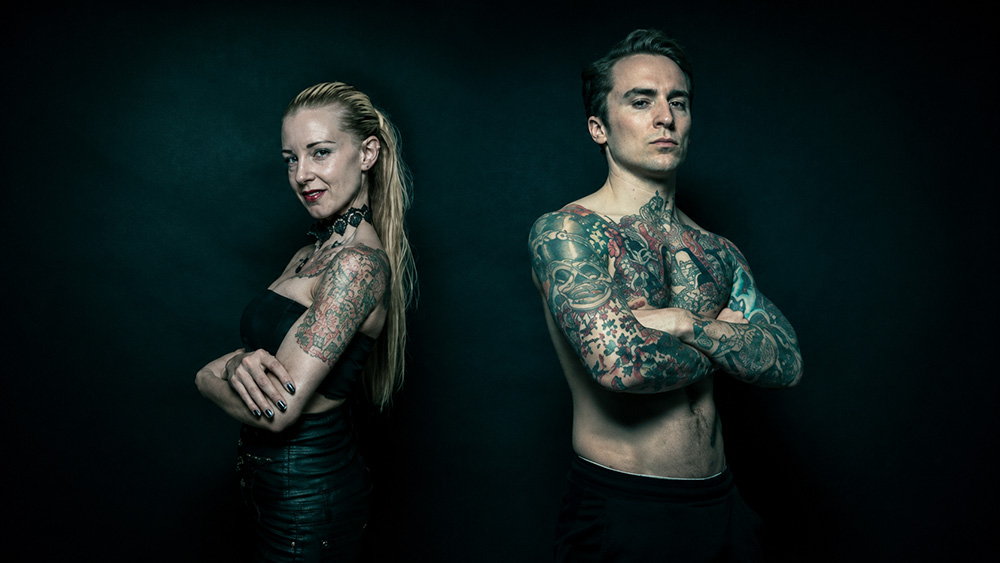
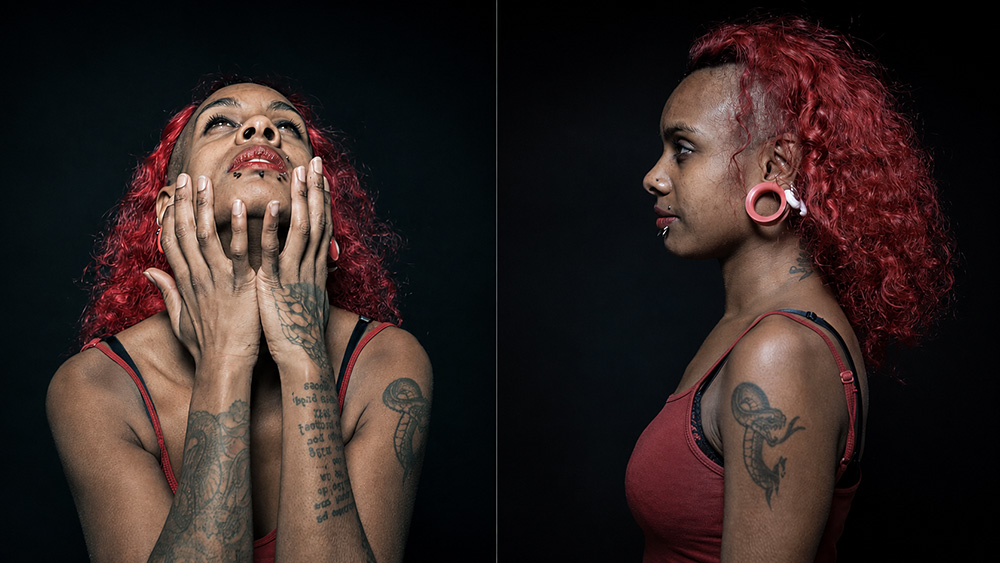
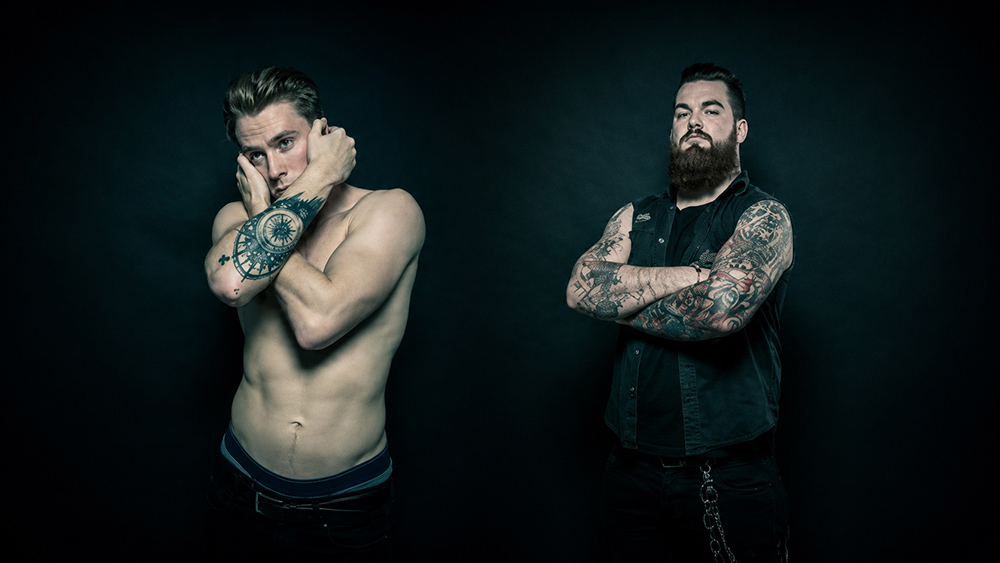
The tattoo portrait series brought this into focus particularly clearly. The photographic environment was controlled. The background remained consistent, the lighting language was similar and the images belonged to the same visual family.
The people, however, were completely different.
Some appeared visually confident but became highly aware of themselves once the camera was raised. Others responded almost immediately. Some wanted very clear guidance. Others naturally began introducing their own gestures and expressions once they understood where the shoot was going.
That was important because the technical environment could remain almost identical, while the human response never did.
The equipment had not changed. The light had not fundamentally changed. I was still the same photographer.
But the person had changed.
BEYOND APPEARANCE
I Wasn't Photographing Tattoos. I Was Photographing People.
Appearance can make a photographer assume too much.
Somebody who is heavily tattooed may appear confident, expressive, rebellious or comfortable with attention. But those things tell me surprisingly little about how they will respond once the camera is pointed towards them.
The tattoos were part of their visual identity, but they were not the whole portrait.
I needed to move beyond the immediate visual label and concentrate on the actual individual standing in front of me.
Appearance tells me what someone looks like. Behaviour tells me how I should photograph them.
WHAT CHANGED
I Started Watching What Happened After the Instruction
I began looking beyond the pose and paying much closer attention to what happened around it.
Was the person waiting for permission before every movement? Were they looking towards me for reassurance? Did an instruction make them feel more certain or more hesitant? Did their hands begin to relax? Was their movement becoming more instinctive?
Most importantly, I started observing what happened after I gave an instruction.
That was the part I had previously underestimated.
The instruction itself was only half the information.
The response told me what I needed to do next.
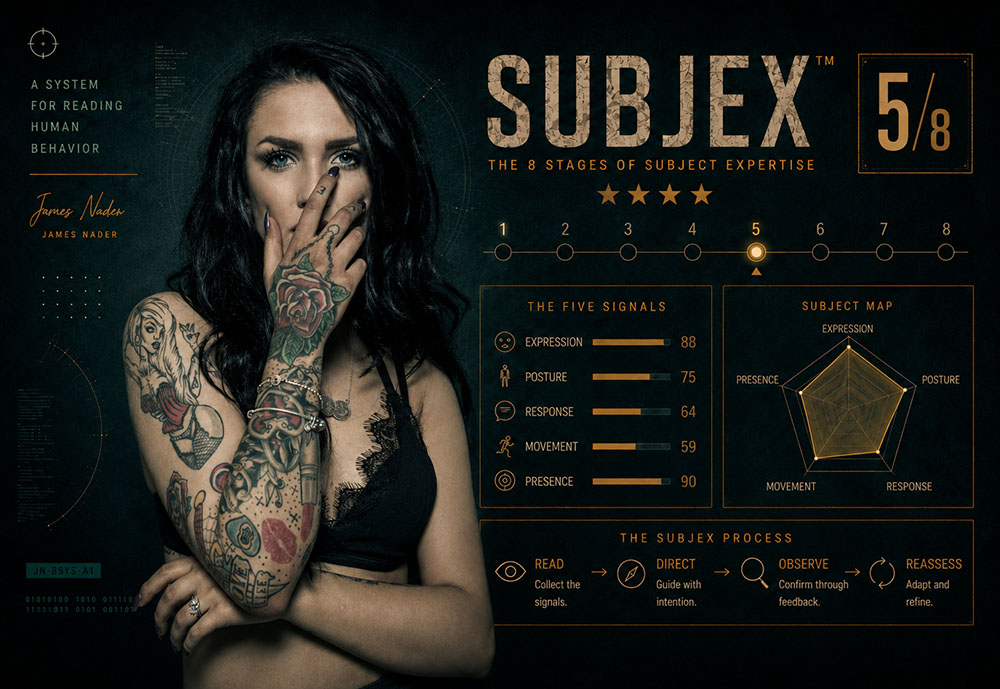
THE SUBJEX™ RESPONSE LOOP
Read. Direct. Observe. Reassess.
SUBJEX™ became a continuous feedback loop between photographer and subject rather than a fixed sequence of instructions.
THE 1–8 SYSTEM
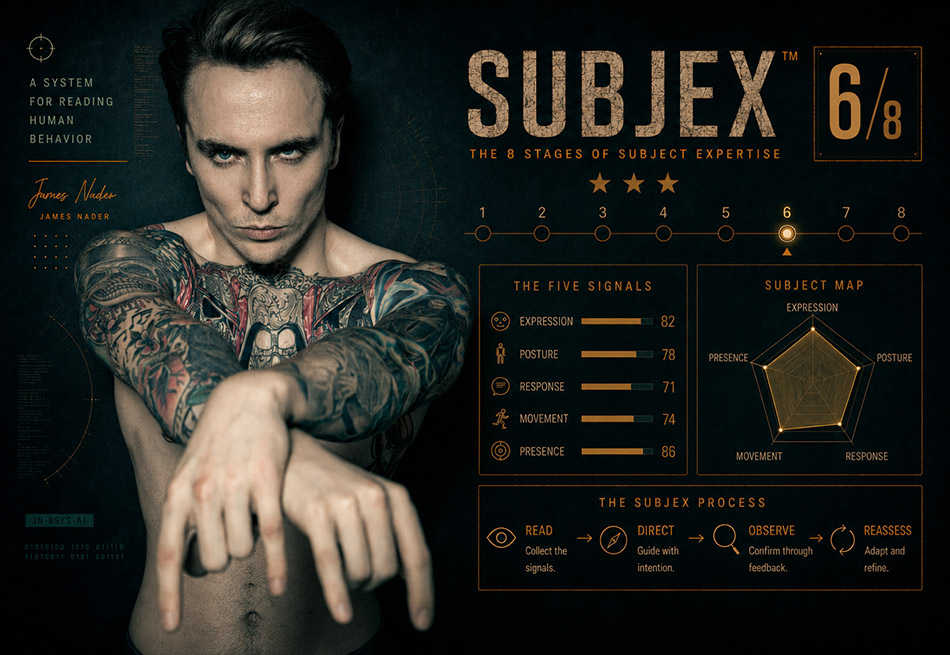
The Eight SUBJEX™ Stages
Over time, I began recognising recurring states in the way people responded to the camera, the photographer and the experience of being photographed.
I organised those observations into eight stages.
The number is not a judgement. It is not a score for attractiveness, personality or modelling ability. It simply helps describe where the person appears to be at that particular moment.
Closed
Guarded, apprehensive or withdrawn. Direction should create clarity, reassurance and security.
Aware
Highly conscious of the camera, appearance and body position.
Responsive
Beginning to understand, trust and respond to the photographer.
Comfortable
Physical and psychological tension begins to reduce.
Engaged
The subject is participating rather than simply following instructions.
Present
Attention begins to move away from being photographed and towards the photograph itself.
Connected
Photographer and subject increasingly read and respond to one another.
Generative
The subject begins contributing useful movement, expression and ideas to the photograph.
Eight Is Not the Objective.
SUBJEX™ is not about pushing everybody towards the same behaviour.
A quiet subject can be completely connected. A highly expressive subject can still be very aware of the camera.
The number helps me understand what is happening so that I can respond appropriately.
The objective is to create the strongest photograph of the person who is actually there.
THE FIVE SIGNALS
What Am I Actually Looking At?
To make the reading practical, I pay attention to several signals rather than judging a subject through one pose or one expression.
I am watching how the person's expression, posture, response, movement and presence change as the interaction develops.
The stars are not intended as scientific measurements. They are visual shorthand.
Their purpose is to make me stop, observe and evaluate rather than assume.
HOW I RESPOND
The Direction Changes. It Does Not Disappear.
I do not believe SUBJEX™ is about progressively giving less direction.
Clear direction is often exactly what makes somebody feel safe and confident in front of a camera.
What changes is the nature of that direction and the way it is communicated.
WHAT I LEARNED
How Direction Changes the Way a Subject Feels
I do not believe the answer is simply to give less direction. In many portrait sessions, clear direction is exactly what helps the subject relax. The difference is in how that direction is given.
If someone is uncertain in front of the camera, vague instruction can make them more self-conscious. They do not know what I want, they begin questioning themselves and that uncertainty starts to show.
So I help them.
I may change the position of a hand, alter the angle of the shoulders, ask them to shift their weight or change where their eyes are looking. But the important part is not simply the instruction itself.
It is the way I deliver it.
The person needs to feel that I know where we are going.
They need to feel that I am not correcting them because they are doing something wrong. I am simply guiding the photograph.
If every instruction feels like criticism, the person can become increasingly aware of themselves. They begin questioning their hands, their expression and the way they are standing.
The same direction delivered with confidence, reassurance and purpose can have exactly the opposite effect.
It removes uncertainty.
It gives them something definite to respond to.
And as they begin trusting the process, they often become increasingly comfortable.
THE PHOTOGRAPHER
I Have to Change First.
When a portrait is not working, it is very easy to describe the person as awkward, nervous or difficult.
Those descriptions do not solve anything.
A much more useful question is:
What can I change?
Perhaps my instruction needs to be clearer. Perhaps I am moving too quickly. Perhaps the person needs reassurance. Perhaps I have assumed they understand something that I have not actually explained.
Perhaps there are too many people watching.
Perhaps I need to change the way I am communicating entirely.
The photographer is part of the system.
If my behaviour can create uncertainty, it can also create confidence.
TRY THIS
Read Your Next Subject Before You Judge the Portrait
On your next portrait session, use the first few frames as information as well as photographs.
Watch the person's expression, posture, movement, response and presence.
Give a clear instruction.
Then watch what happens.
Did it create confidence? Did the body relax? Did the person understand what you wanted? Did they become more engaged? Or did the instruction create uncertainty?
Then ask yourself:
Where are they right now?
And then:
What do they need from me next?
That second question is perhaps the most important one in the whole system.
FIELD NOTES
10 SUBJEX™ Takeaways
Read the person before assuming how they should be directed.
Direction is communication, not simply instruction.
Clear direction can create confidence rather than self-consciousness.
The same instruction can affect two people in completely different ways.
Watch what happens after every important instruction.
SUBJEX™ is a live reading, not a personality label.
A subject can move forwards or backwards during the same session.
The quality and delivery of direction matter more than simply the amount.
If the portrait stalls, examine your own communication before blaming the subject.
Strong portraits develop when direction, confidence, observation and recognition begin working together.
LEARN SUBJEX™
Start With the Framework. Then Learn to Apply It.
Once I began formalising SUBJEX™, I realised that the same framework could help other photographers who were struggling with subject direction, communication and confidence.
You can understand your camera, know lighting, learn composition and memorise dozens of poses, yet still struggle if you cannot read how the person in front of you is receiving your direction.
The free version introduces the eight stages and the core principles. The complete system goes further into how I recognise changes, adapt language and work with different people in real portrait situations.
FREE
SUBJEX™ Introduction
Learn the eight stages and begin applying the basic reading framework to your next portrait session.
Download Free GuideCOMPLETE SYSTEM
Learn SUBJEX™ in Depth
Go deeper into subject behaviour, direction, confidence, regression, communication and practical application with professional models, non-models and real portrait subjects.
Explore SUBJEX™FAQ
SUBJEX™ and Portrait Direction
What is SUBJEX™?
SUBJEX™ is my eight-stage framework for reading how a person is responding to the photographer, the direction and the camera, then adapting the way I work accordingly.
Is SUBJEX™ a posing system?
No. Posing can form part of the direction, but SUBJEX™ is about understanding how the person is receiving that direction and determining what they need next.
Should nervous subjects receive less direction?
Not necessarily. Clear and reassuring direction can remove uncertainty. What matters is how the direction is communicated and how the person responds.
How do you make someone feel more natural in a portrait?
I concentrate on clarity, reassurance and communication. Rather than simply telling someone to relax, I give them something clear to do and then watch how that direction changes the way they respond.
Does SUBJEX™ work with professional models?
Yes. Experienced models may move through the stages more rapidly, but they still need to be read as individuals rather than treated according to assumptions.
Does every subject need to reach SUBJEX 8?
No. Eight is not the objective. The purpose is to understand where somebody is and create the strongest portrait possible from the person actually in front of you.
Can the SUBJEX™ reading change during a shoot?
Yes. Confidence, engagement, response and camera awareness can change continuously, which is why I treat SUBJEX™ as a live reading rather than a permanent label.
What are the five SUBJEX™ signals?
I look at expression, posture, response, movement and presence. Together they give me a broader picture of how the person is responding rather than relying on one pose or facial expression.
Why is direction important in portrait photography?
Good direction removes uncertainty. It helps the person understand what the photographer wants and gives them confidence that the session is moving somewhere purposeful.
How can photographers improve their direction?
Start by observing the result of each instruction. The important question is not simply whether the person followed it, but whether it created greater confidence, connection and presence.
THE BIGGER LESSON
The Camera Records Decisions Already Made.
Before I press the shutter, decisions have already been made about light, composition, position, timing and direction.
SUBJEX™ adds another:
What does this person need from me right now?
Sometimes that means giving very clear direction.
Sometimes it means reassurance.
Sometimes it means changing the way I communicate exactly the same idea.
The important part is recognising the person before simply applying technique.
I originally thought I needed to become better at directing people.
What SUBJEX™ taught me was that I first needed to become better at reading them.
SUBJEX™
Read the person.
Direct with purpose.
Recognise the photograph.
PHOTOGRAPHER | DIRECTOR | EDUCATOR
JAMES NADER
No Comments